

The harmonium has a steady, continuous tone that feels almost like singing with another person. In this post, I share a little of its history, my own harmonium, and the way its sound blends with the voice.
I first came across the harmonium a few years ago and was drawn to its steady, continuous tone. To me, it feels a little like singing with another person.
A Brief History
Harmoniums originated in the early 1800s in Europe and were developed to bring an organ-like sound into homes and smaller settings where a full pipe organ wasn’t practical.
They looked like small organs, but instead of pipes they used metal reeds to produce sound, which allowed them to be much smaller. These early versions used foot pumps to move air through the reeds.
In the mid-1800s, these early foot-pumped reed organs, or harmoniums, were brought to India.
The instrument was soon embraced in devotional and everyday settings after it was modified with hand-pumped bellows, making it better suited to the existing tradition of sitting on the floor for music-making.
When the harmonium was first introduced to India, classical musicians were hesitant because it couldn’t capture the subtle pitch variations of their traditional music. At one point, it was even banned on All India Radio for classical broadcasts!
However, it was eventually accepted because it was practical, reliable, and effective as a supporting instrument for the voice.
Today, the harmonium is widely used in South Asian music and kirtan groups around the world, usually supporting the voice with a drone or simple harmony rather than full chords. Interestingly, although it originated in Europe, it found its most lasting home in South Asian music.
My Own Harmonium
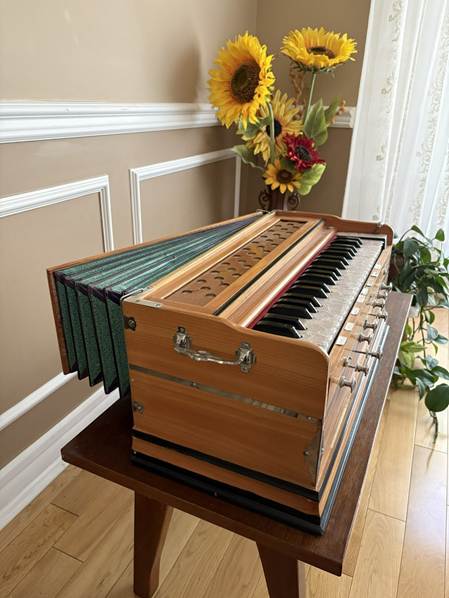
I’ve included a photo of my own harmonium here. On the front is a row of stops that shape the sound of the instrument. They create drone notes, open and close different sets of reeds, and produce a gentle tremolo that adds a soft wavering quality. A small lever on the side brings in another octave, giving the sound a fuller feel. All of these features support the voice.
I keep mine on a small table my father made for me many years ago and sit on a stool, a practical setup that lets me play comfortably. When I first begin to play, I often notice the distinct scent of wood rising from the instrument. It adds to the quiet, handmade feeling of the experience. The bellows also remind me of breathing: air moving in and out, giving the instrument its voice.
Listening To The Sound
This short clip uses two drone stops and one simple Om, giving a sense of how the voice can rest within the harmonium’s steady sound.
You can also listen to my Asato Ma post for a fuller sense of how the voice and harmonium blend together.
What draws me to the harmonium is its simplicity and steadiness, the way it quietly holds space for the voice to rest and move.