
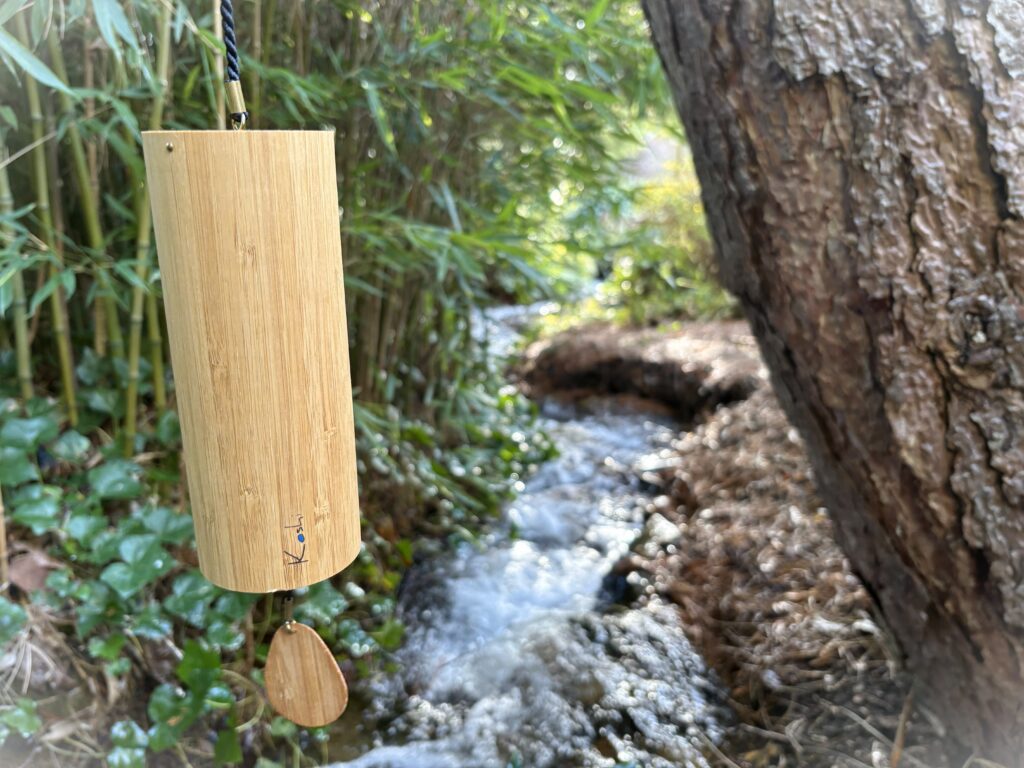
A quiet invitation to slow down, listen, and notice how sound can gently bring awareness back to the body.
Tuned and Untuned Chimes
Most wind chimes you see in stores aren’t actually tuned — the tubes are cut without much attention to pitch, so the sound can feel a bit sharp or unpredictable. Tuned chimes are different. Their tubes are carefully measured so the notes relate to one another, creating a more balanced and gentle sound. Even a simple tuned chime tends to feel more settled than a generic one. Untuned chimes have their own appeal too — I enjoy how mine simply marks the presence of wind — but I listen to them differently than I do a Koshi.
The Sound of a Koshi
Koshi chimes take this idea of tuning a step further. Hand-crafted in the Pyrenees Mountains in France, each Koshi chime is built with eight metal rods inside a bamboo resonator, tuned so the tones flow together in a soft, seamless way. Instead of creating a melody (which often engages the thinking mind), they create a gentle wash of sound — something more like an atmosphere than a tune, felt by the body as much as heard by the ears.
Part of what makes Koshi chimes so relaxing is the way they’re tuned. The notes are chosen to blend effortlessly, with no sharp tension in the sound, so your body naturally softens as you listen. They aren’t based on Western musical modes, but they work in a similar way: each one uses a specific set of notes that creates its own emotional color or atmosphere.
A Circular Quality of Sound
The sound often feels calm and circular. Unlike many Western scales, which tend to create a strong sense of a “home” note — the familiar do from solfège — that the music wants to return to, Koshi chimes don’t pull the ear toward resolution. The tones simply rise, mingle, and fade on their own. This creates a feeling of openness rather than direction — more like a sound that surrounds you than a melody that needs to resolve.
Koshi chimes come in four elemental tunings — Earth, Water, Air, and Fire — each with its own natural feel: grounding, flowing, uplifting, or warm. Their gentle, circular quality is why many people use them for meditation, grounding, or simply creating a peaceful atmosphere at home.
Listening Exploration
I’ve noticed that the sounds produced by a Koshi chime can vary quite a bit depending on how it’s moved. Sometimes the sound is more lively, and other times it’s softer. When I hold mine very gently, the tones seem to drift and settle in a way that feels calming to me. It’s interesting how small differences in movement can change the feeling of the sound.
Below are two separate recordings of my Water Koshi, each about two minutes long. In the first, the chime has a larger sway, which brings out a more active, shimmering sound. In the second, the movement is slower and softer, allowing the tones to linger more quietly. There’s no right or wrong here — just different qualities to explore as you listen.
Let the chime do the work and allow it to meet you where you are, without effort. Notice how it feels in your body as the tones drift by.
Most of the time, I prefer the quieter, more spacious sound that comes with gentler movement. It often brings me back to a time when life felt simpler — perhaps even before language.
After Listening
As you listen, you may become more aware of your body. You might take a deeper breath, feel a small release, or even find a yawn rising. The effects are subtle, but very real.
It can be helpful to give yourself a few moments afterward to let that awareness settle. You might stretch, take a few slow breaths, look out the window, or simply sit quietly for a moment — anything that helps your system integrate what it felt.
This recording uses more movement of the Koshi Chime:
This recording uses gentler movement of the Koshi Chime: